How Old Is an Open Job Posting?
Counting the age of 592,013 open postings on 15,403 employers’ own career sites on 10 November 2026, to test the advice that a posting more than 30 days old is probably not a real opening.
Advice for job seekers often says to check how long a posting has been up. One guide says a job that has been live for more than 30 days is “likely a ghost”, meaning a posting that nobody is hiring for (The Interview Guys). In February 2026 a study of Indeed counted every listing that had been active for 30 days or more as a potential ghost job and found about one in seven (Clarify Capital).
My company, Within Noise, sells a tool that reads job openings directly from employers’ own career sites. Building its search index put the posting dates of more than a million open jobs in one place on one day, so I wanted to see whether the 30-day rule fits what employers’ own sites show.
What I found
- Most open postings were more than a month old. Of 592,013 postings with an exact date, 63% were older than 30 days (95% range 58% to 67%). The median posting was 55 days old (46 to 68).
- That is much higher than the one in seven reported for Indeed. The share older than 30 days on employers’ own sites was more than four times the share reported for Indeed listings. The two counts differ in where the listings come from and in how each one gets its date, and these data cannot say which difference matters most.
- Some postings were very old. 16% were more than a year old (12% to 21%), and 41% of employers had at least one posting that old.
- A typical employer’s board looked the same. Counting each employer once, the middle employer had 75% of its postings older than 30 days.
- The hiring platform mattered more than the size of the employer. The share of postings older than 90 days ran from 31% on one platform to 64% on another. Small and large employers could not be told apart.
In practice, a 30-day cutoff would exclude about two thirds of the postings on these career sites. These data cannot say which postings are real. They do show that most postings are older than 30 days, so age on its own cannot identify a suspicious minority.
1. The 30-day rule
A ghost job is a posting with no active hiring behind it. Greenhouse, a company that makes hiring software, said that in any given quarter between 18% and 22% of the jobs posted on its platform are classified as ghost jobs, which it describes as positions advertised with no intent to hire (Greenhouse, 10 December 2024). Greenhouse does not say how it decides that a posting is one.
A job seeker cannot see intent, so the advice relies on something a job seeker can see: the date. The guide quoted above tells readers to check the posting date and treats more than 30 days as the mark. Peter Duris, the CEO and co-founder of Kickresume, told Fortune that a job posting a couple of months old should be treated as a warning sign (Fortune, 28 January 2025). Clarify Capital, a company that arranges business loans, measured the same idea. It collected 176,268 job listings from Indeed in February 2026, measured each listing’s age from the posting date shown on Indeed to the day of collection, and flagged every listing that had been active for 30 days or more as a potential ghost job. About one in seven listings met that mark, and 4% had been up for four months or more.
The 30-day mark is close to how long hiring is reported to take. SHRM, an association for people who work in human resources, reports in its 2026 benchmarking survey that organizations took a median of 39 calendar days to fill a job below executive level, down from 44 days in its 2025 survey (SHRM 2026, SHRM 2025). SHRM counts the days from opening the job requisition to a candidate accepting an offer. In a study based on what United States employers told the government’s job-openings survey from 2001 to 2006, the authors estimated that a job opening took about 20 working days to fill on average (Davis et al. 2013). That figure is worked out from counts of openings and hires; employers did not report the durations themselves.
There is a reason to expect open postings to look older than those figures, even if every posting is real. A count of the postings open on one day is not the same as a count of all postings. A posting that stays open for six months is on the site on about six times as many days as a posting that stays open for one month, so a single day’s count is about six times as likely to include it. Economists who study unemployment have long pointed out the same effect: counting the people who are unemployed on one day “weights longer spells more heavily”, because longer spells are more likely than shorter ones to be in progress on the day of the count (Clark and Summers 1979).
So two things can be true together. Most jobs can be filled in about a month, and a large share of the postings open today can still be older than that.
2. Reading the dates from employers’ own sites
Most companies run their careers page on a hiring platform such as Greenhouse, Lever or Workday. Each platform publishes the employer’s open jobs in a public feed, which is what the careers page itself displays. The feed carries the date the platform gives for each posting. The tool reads those feeds, and its index has one row per open posting: the title, the locations, and that date.
The index used here was built on 10 November 2026. It covers 26,337 employers on 12 hiring platforms. For this question I could use the 592,013 postings at 15,403 employers on the eight platforms that give an exact date for every posting, which I call the dated platforms: Greenhouse, Lever, Ashby, SmartRecruiters, Recruitee, Teamtailor, Personio and Breezy HR.
A posting’s age is the number of days from its posting date to 10 November 2026. Four choices mattered:
- I took the date as the platform reports it. An employer can close a posting and open it again, which resets the date. The ages here are therefore the shortest each role can have been open.
- I counted in two ways. Pooling every posting answers “what does a job seeker browsing these sites see?”, and an employer with 2,000 postings counts 2,000 times. Taking one value per employer and then the middle employer answers “what is a typical employer’s board like?”.
- Workday is used for one question only. Its listing says “Posted 12 Days Ago” for recent postings and “Posted 30+ Days Ago” for everything older, so it can say whether a posting is older than 30 days and nothing more.
- Three platforms are left out. BambooHR, Rippling and Pinpoint do not put a posting date in their listing. A thirteenth platform, Workable, is not in this index at all because its feed limited how fast I could read it.
The employers are not a sample of all employers. The list of job boards came from Common Crawl, a public archive of web pages: I took every board address on these platforms that appeared in four of its 2026 crawls and kept the ones whose feed answered with at least one open job. That favours employers whose careers pages are linked from elsewhere on the web, and these platforms are used more by technology companies than by, for example, restaurants or hospitals.
3. What I decided in advance
With this much data, some way of dividing it will always produce a surprising number. One effective protection against that is to write down the questions and the tests before seeing the results (Nosek et al. 2018). The questions and the rules for answering them were committed to the project’s repository on 10 November 2026, before any posting date had been read, and the sixth was added an hour later, still before any date had been read (the plan as committed). The repository is private because it contains the tool’s code, so the commit cannot be inspected from outside.
| Question | What would count as yes | Result |
|---|---|---|
| 1. Is the typical open posting less than a month old? | The median age on dated platforms is 30 days or less | No. The median was 55 days (46 to 68). |
| 2. Are postings older than 90 days uncommon? | Fewer than 10% of postings are older than 90 days | No. 39% were (35% to 43%). |
| 3. Does the answer depend on the hiring platform? | Among platforms with at least 200 employers, the highest share older than 90 days is at least twice the lowest, and their ranges do not overlap | Yes. 64% on Personio against 31% on Breezy HR. |
| 4. Do large employers have older postings than small ones? | The share older than 90 days differs by at least 5 points, and the ranges do not overlap | No. 40% against 44%, a difference of 4.5 points with overlapping ranges. |
| 5. Does Workday look like the dated platforms at the 30-day mark? | Workday’s share older than 30 days is within 10 points | No. 51% on Workday (49% to 53%) against 63%, a gap of 12.3 points. |
| 6. Is the share older than 30 days close to the one in seven reported for Indeed? | The share is between 9% and 19% | No. It was 63% (58% to 67%). |
Sections 4 and 6 also report three checks that I added after seeing these results. They are marked where they appear.
4. How old the postings were
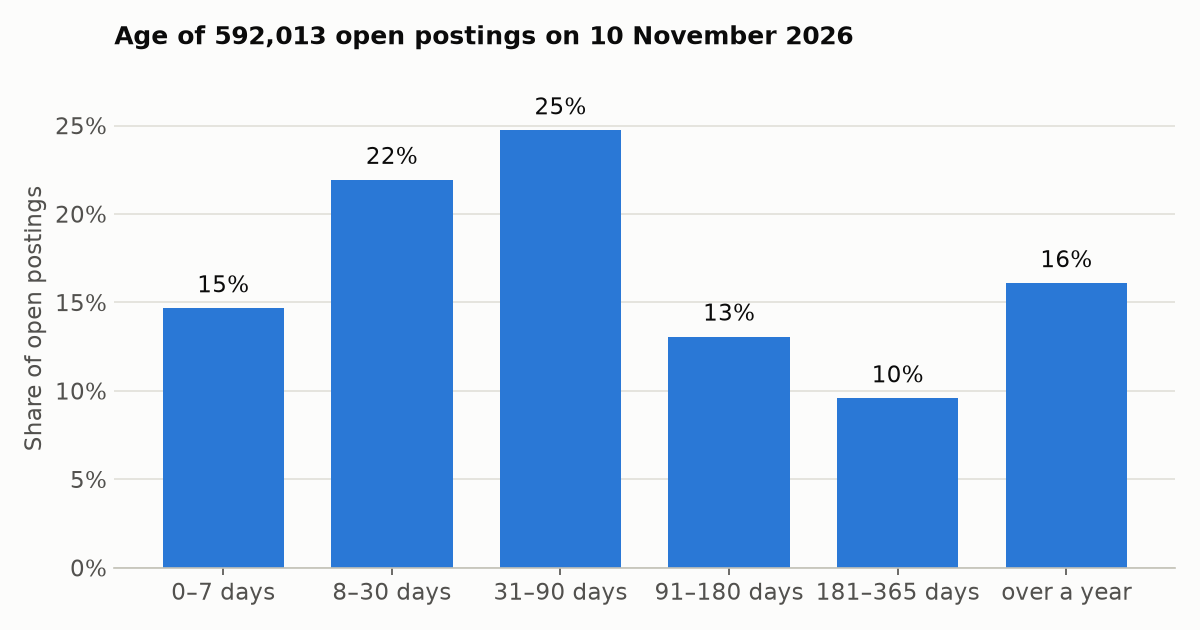
About one posting in seven (15%) was a week old or less, and 37% were 30 days old or less. The other 63% were older than 30 days. Half of all postings were more than 55 days old, a quarter were more than 188 days old, and a tenth were more than 691 days old, which is almost two years.
Counting each employer once gives a similar result. The middle employer had 75% of its postings older than 30 days and 34% older than 90 days (33% to 36%). The middle employer’s median posting was 63 days old (62 to 65).
Very old postings were found at many employers. 16% of all postings were more than a year old, and 41% of employers had at least one of those. The oldest posting in the data was dated 6,184 days before the snapshot, which is nearly 17 years.
I ran three checks after seeing these numbers, to see whether one kind of posting explained them.
- Standing invitations. Some postings are not one opening but a permanent invitation, with titles such as “General application” or “Talent pool”. I found 4,272 postings with titles like that, 0.7% of the total, and 84% of them were older than 90 days. Removing them left the share older than 30 days at 63% and the median at 55 days.
- Dates that may predate publication. Personio and Lever name their date field “created”, which could be the day the job was entered into the system, not the day it went public. Without those two platforms the share older than 30 days was 63% (58% to 67%) and the median was 54 days.
- Ignoring everything over a year old. Among postings one year old or less, 56% were older than 30 days and the median was 39 days.
None of the three checks changes the answer to the first two questions.
5. Compared with Indeed
Clarify Capital found about 14% of Indeed listings at or past 30 days. On employers’ own sites I found 63% past 30 days. A difference that large is not due to chance, but these data cannot say what causes it. There are at least three possible explanations, and I have not tested any of them.
- The date may mean different things. Clarify measured from the posting date shown on Indeed. A listing that is posted to Indeed again, or refreshed there, may show a newer date than the employer’s own system has for the same job.
- Listings may not stay on Indeed as long as they stay on a careers page. A posting that an employer leaves on its own site for a year need not be on a job board for a year.
- The employers differ. Indeed carries listings from every kind of employer. The employers here are the ones whose career sites run on eight particular platforms.
What can be said is narrower. A rule that flags about one listing in seven on Indeed flags about two in three on these employers’ own sites.
6. Platforms and employer size
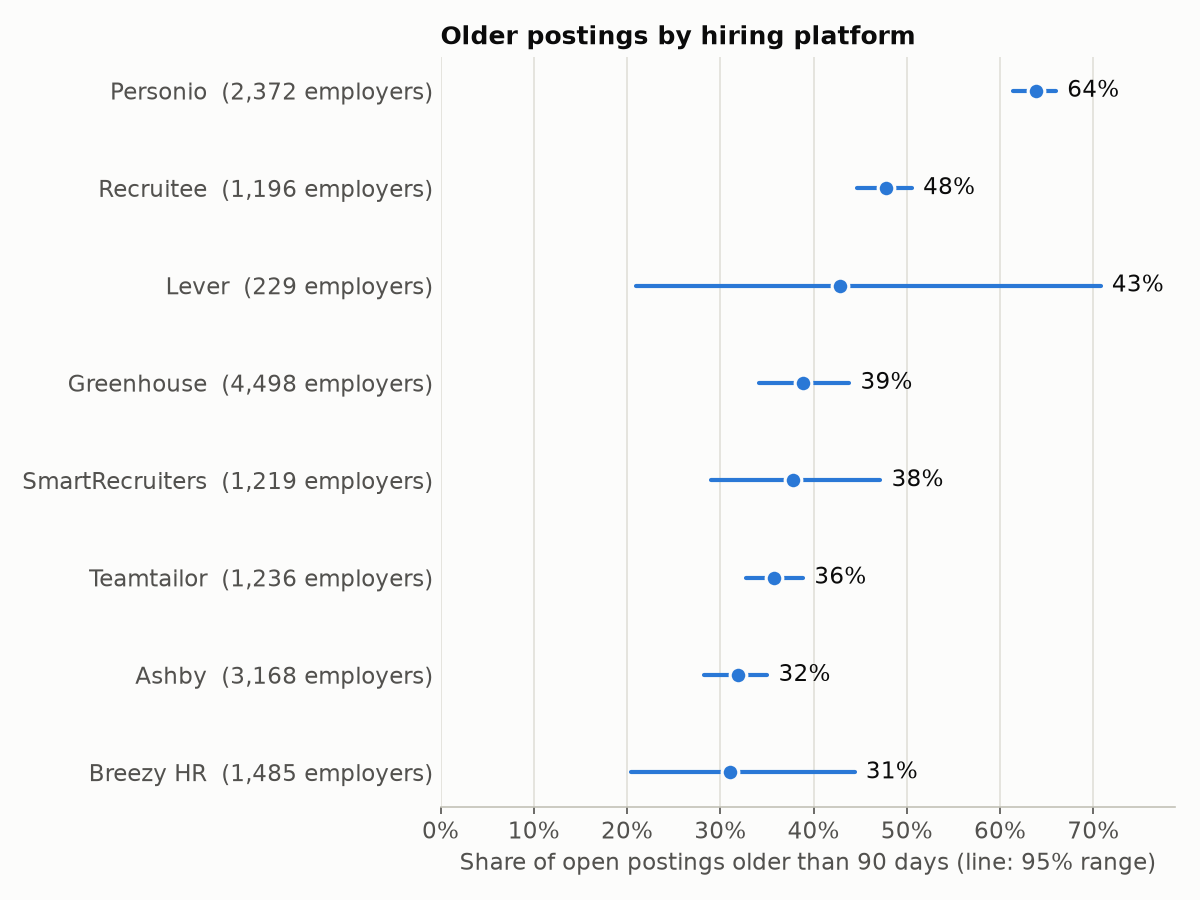
The platforms differ. On Personio, 64% of postings were older than 90 days (61% to 66%). On Breezy HR the share was 31% (20% to 44%) and on Ashby 32% (28% to 35%). Personio’s date may be a creation date, as section 4 notes, so part of its difference may come from what the date means. Recruitee was the next highest at 48% (45% to 51%), and its feed names the date “published”.
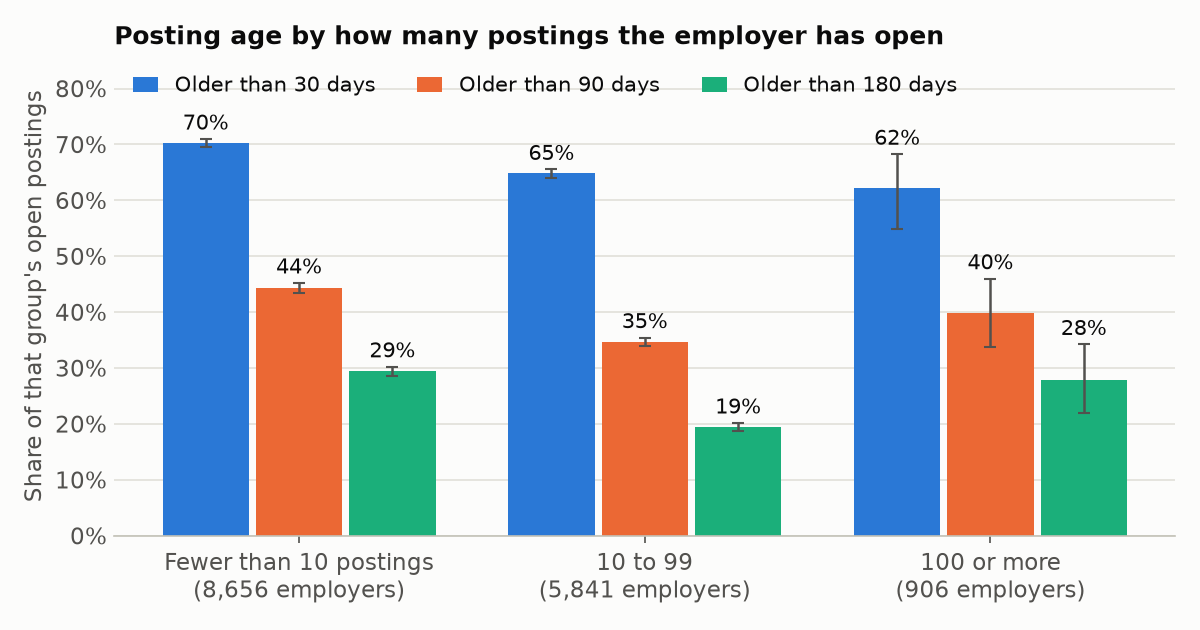
Employer size made no clear difference. Employers with fewer than 10 open postings had 44% of them older than 90 days (44% to 45%), and employers with 100 or more had 40% (34% to 46%). The difference of 4.5 points has a 95% range from 10.5 points lower to 2.0 points higher, which includes zero. The 906 large employers have two thirds of all the postings, and a few of them are very large, which is why their range is wide. I had not planned to look at the middle group, but it is in the figure: employers with 10 to 99 postings had the lowest share, 35%.
Workday could be checked only at the 30-day mark. Of 622,041 postings at 4,016 employers on Workday, 51% were marked “Posted 30+ Days Ago” (49% to 53%). That is 12.3 points below the dated platforms, outside the 10 points I had set, so by the rule I wrote the answer to question 5 is no. On Workday too, about half of the open postings were more than a month old.
7. What could be wrong
- A posting can be reposted. Closing a posting and opening it again resets its date. That makes postings look younger than the roles are, so it would make the main finding smaller, not larger.
- The date fields are not identical. Each platform names and fills its date in its own way. Section 4 checks the two platforms whose field is called “created”, but I have not confirmed with any platform what its date records.
- The employers were not drawn at random. They are the employers whose job boards appear in a public web archive, on eight platforms. Employers that hire through other systems, or whose boards are not linked from the wider web, are missing. The result describes these 15,403 employers.
- It is one day. Hiring may differ by season, and a count taken in March could give different numbers.
- An old posting is not necessarily fake, and a new one is not necessarily real. Nothing here measures whether anyone is hiring for a posting. A year-old posting may be a role that is always open, such as a nurse or a driver. A week-old posting may have no hiring behind it.
- I have a commercial interest. My company sells the tool that collected the data, and a finding that career sites differ from job boards helps to sell it. The plan in section 3 was written first for that reason.
8. What I take from this
On these employers’ own career sites, a posting older than 30 days was the usual case. The median open posting was 55 days old. That does not contradict the reports that a job takes about a month to fill, because a count taken on one day includes a larger share of the postings that stay open longest.
This does not show that the advice is wrong about Indeed, and it does not show that ghost jobs are rare. It shows that on a careers page, the date alone distinguishes very little: a job seeker who skipped everything older than 30 days would skip most of the postings.
I would like to repeat the count on another day, and to follow the same postings over time. Following them would give the measure this snapshot cannot: how long a posting stays up from start to finish.
Details for anyone who wants to check the work
A. Data
- Snapshot: every feed was read on 10 November 2026, between about 16:30 and 19:30 UTC. Ages are whole days from the posting’s date to 10 November 2026.
- Job boards: board addresses on the 12 platforms were taken from the URL indexes of four Common Crawl crawls (CC-MAIN-2026-30, -34, -39 and -43), which gave 43,002 candidate addresses. A candidate was kept when its feed answered with at least one open posting.
- Dated platforms, employers and postings listed: Greenhouse 4,499 and 175,554; SmartRecruiters 1,219 and 231,167; Ashby 3,168 and 61,044; Lever 229 and 26,865; Breezy HR 1,485 and 28,290; Teamtailor 1,236 and 23,576; Recruitee 1,196 and 23,095; Personio 2,372 and 22,480. The total is 15,404 employers and 592,071 postings.
- Date field read from each feed: Greenhouse
first_published; LevercreatedAt; AshbypublishedAt; SmartRecruitersreleasedDate; Recruiteepublished_at, orcreated_atwhen that is empty; Teamtailordate_published; PersoniocreatedAt; Breezy HRpublished_date. Workday gives the text “Posted N Days Ago”. - Exclusions: 58 postings on dated platforms had no date and were left out, which removed one Greenhouse employer whose postings were all undated. No posting was dated in the future or before 2005. That leaves 592,013 postings at 15,403 employers.
- Workday: 4,016 employers and 622,041 postings. A posting marked “Posted 30+ Days Ago” counts as older than 30 days. In the last two passes, an employer with more than 20,000 postings was read only up to about 20,000.
- Not used for ages: BambooHR (5,387 employers, 39,418 postings), Rippling (1,423 and 15,358) and Pinpoint (107 and 5,093), whose listings carry no posting date.
B. Method
- Pooled share: postings older than the threshold divided by all postings.
- Per-employer summary: each employer’s own share, or its own median age, and then the median of those values across employers.
- Ranges: 95% bootstrap ranges from 2,000 resamples of whole employers, drawn with replacement. For the size groups and for each platform, employers were resampled within the group.
- Size groups: by the number of dated open postings: fewer than 10 (8,656 employers, 35,013 postings), 10 to 99 (5,841 and 163,794), 100 or more (906 and 393,206).
- Standing-invitation titles: matched by a fixed list of phrases in English, German, French and Dutch, such as “general application”, “talent pool”, “Initiativbewerbung” and “candidature spontanée”.
C. Full results
- Question 1: pooled median 55 days (46 to 68). Quartiles 16, 55 and 188 days; 90th percentile 691 days. Median across employers of each employer’s median: 63 days (62 to 65).
- Question 2 and other thresholds, pooled: older than 30 days 63.4% (58.1% to 67.5%); 90 days 38.7% (34.6% to 42.8%); 180 days 25.6% (21.8% to 30.0%); 365 days 16.1% (12.3% to 20.5%). A week old or less: 14.7%. Older than two years: 9.6%.
- The same thresholds for the middle employer: 30 days 75.0%; 90 days 34.4% (33.3% to 36.0%); 180 days 12.4% (11.1% to 12.5%); 365 days 0%.
- Question 3, share older than 90 days: Breezy HR 31.0% (20.4% to 44.4%); Ashby 31.9% (28.2% to 35.1%); Teamtailor 35.8% (32.8% to 38.9%); SmartRecruiters 37.8% (29.0% to 47.2%); Greenhouse 38.9% (34.2% to 43.8%); Lever 42.9% (20.9% to 70.8%); Recruitee 47.7% (44.7% to 50.6%); Personio 63.9% (61.4% to 66.0%). The highest is 2.06 times the lowest.
- Question 4, share older than 90 days: small 44.4% (43.5% to 45.2%); medium 34.7% (33.9% to 35.4%); large 39.9% (33.8% to 46.0%). Large minus small: −4.5 points (−10.5 to +2.0).
- Question 5: Workday 51.2% older than 30 days (49.3% to 53.0%) against 63.4% on dated platforms, a difference of 12.3 points.
- Question 6: 63.4% against a band of 9% to 19%.
- Checks added after the results: without 4,272 standing-invitation postings, 63.2% older than 30 days (58.4% to 67.3%) and 38.4% older than 90 days, median 55 days. Without Personio and Lever, 62.8% (57.6% to 66.7%) and 37.5%, median 54 days, on 542,668 postings at 12,802 employers. Postings one year old or less: 56.4% older than 30 days, median 39 days.
Things that went wrong while collecting the data, and what was done:
- Name lookups failed on my machine under load. In the first passes, reading many boards at once made the computer’s address lookups fail, and a board that could not be looked up was recorded as an error, not as closed. I stopped those passes, kept only the boards that had answered, and read every remaining address again at a slower rate. In the final pass the errors were 6 for Recruitee, 1 for Personio, 2 for Breezy HR and 9 for Teamtailor. For Greenhouse, Lever, Ashby and SmartRecruiters the first pass had completed with 1, 0, 0 and 5 errors.
- BambooHR: 1,072 of its addresses answered with a web page instead of a feed. BambooHR is not used for ages.
- Workday: 1,151 Workday addresses answered with an error code, such as 403, 422 or 500, and were treated as not being job boards. The read also stalled twice on two employers whose boards are divided into thousands of small categories. After that I set a limit of four minutes per employer; an employer whose listing took longer was left out, and those are counted among the 1,151.
- Workable: its feed began refusing requests during the first pass, so the platform was dropped from this snapshot.
- Lever: only 285 Lever addresses were found, because Common Crawl contains few Lever pages. The 229 that answered include one employer with 4,674 postings, 17% of Lever’s total, which is why Lever’s range in Figure 2 is very wide.
D. Decisions
| Decision | Reason |
|---|---|
| Resample whole employers, not postings | One employer’s postings share a recruiting team and its habits, so they are not independent |
| Report both the pooled count and the middle employer | 906 employers have two thirds of the postings, and a pooled count alone would mostly describe them |
| Use Workday only at the 30-day mark | Its listing gives no date past 30 days |
| Keep very old postings in the main count | Dropping them would be a choice made after seeing them; the count without them is reported beside it |
| Publish totals only, not the list of employers | The verified list of job boards is part of the product my company sells |
E. Reproduction
- Code: the collection and analysis code is in a private repository, because it is the code of the tool. The method above is complete enough to repeat on any collection of the same feeds.
- Numbers: every figure in this post comes from
figures/data.json, written by the analysis script. - Plan:
figures/preregistration.txtis the plan as committed before the dates were read. - Compute: one laptop. Reading the feeds took about three hours across all passes, and the analysis takes under a minute.
How this was made
Claude Code proposed the question, wrote the plan in section 3 before looking at the dates, built the tool that collected the data, ran the analysis, found the references, and drafted the post. I asked for the post and decided to publish it.
Claude checked each citation against its source: against the full text for every source except SHRM’s 2026 survey, where only the public summary was read because the full report is for members.
References
New posts, occasionally
No schedule. Only when there is something worth writing down.